
November 10, 1975 · Lake Superior
Remembering the Edmund Fitzgerald
The map needs JavaScript turned on. The same hours are written out further down this page.
Every November 9, 10 and 11 this map follows the Fitzgerald, and then the search for her, hour for hour, the way it went in 1975. The rest of the year you can replay it: the replay stops on each event long enough to read it. Tap a dot on the map or a line in the log to go to that moment. Spread two fingers on the map to zoom in.
The Mighty Fitz
The biggest ship ever lost on the Great Lakes went down in a November storm with all 29 men aboard. More than fifty years later, a bell at Whitefish Point still rings once for each of them.
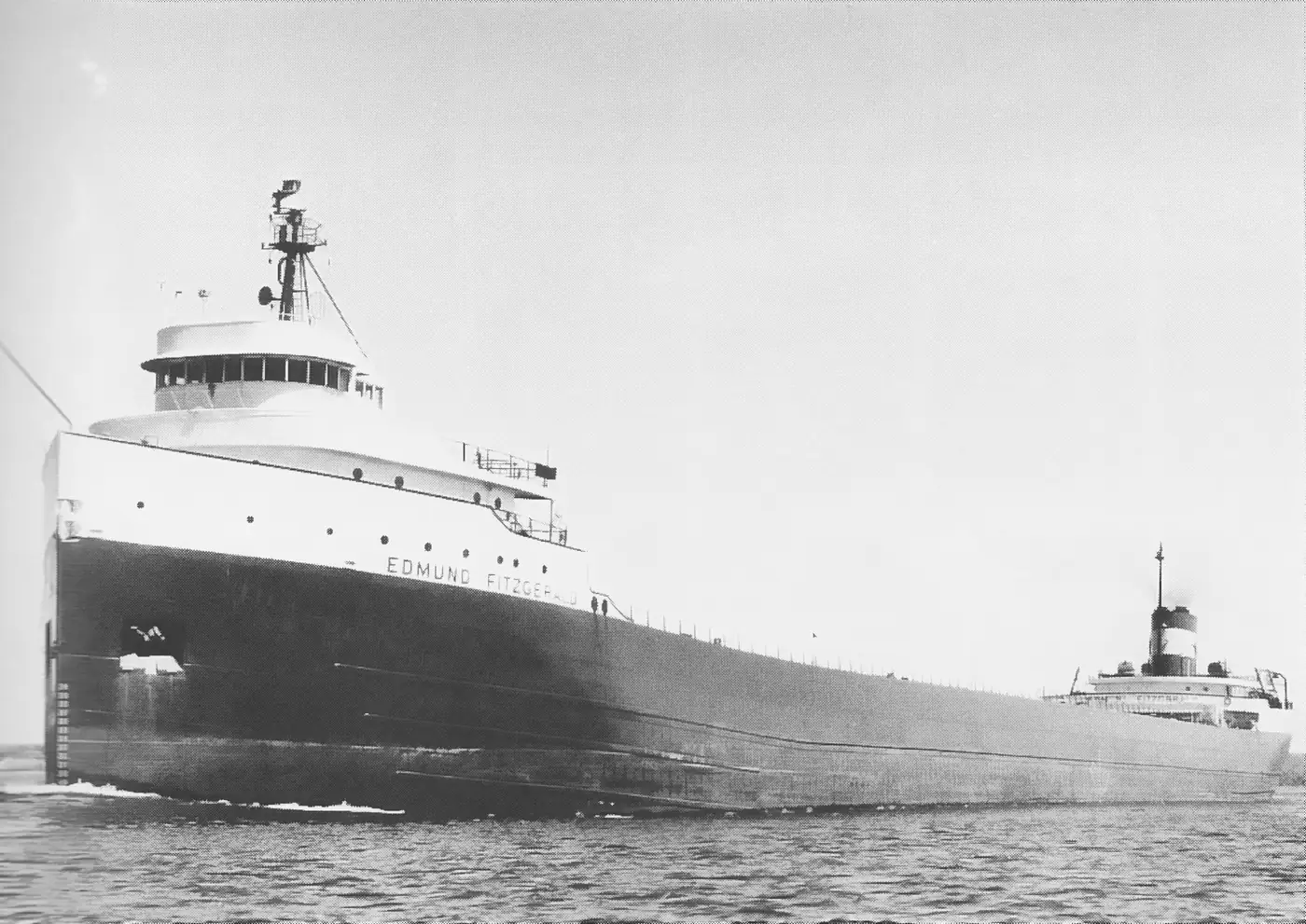
- 729feet long, the biggest ship on the lakes the day she launched
- 26,116long tons of iron ore in her hold that night
- 35foot waves, with gusts over 80 mph
- 29men aboard, and every one of them was lost
The biggest ship on the lakes
When the Edmund Fitzgerald slid into the water at River Rouge, Michigan, on June 7, 1958, she was the largest ship on the Great Lakes. At 729 feet she was longer than two football fields set end to end, and more than 15,000 people came out to watch her launch.
For 17 seasons she carried iron ore from the mines near Duluth to the steel mills around Detroit and Toledo. She set the record for a season's haul six times, often by beating her own, and boat watchers all over the lakes knew her on sight. They called her the Mighty Fitz.
Into the storm
-
November 9, 2:15 PM
The Fitzgerald leaves Superior, Wisconsin, with Captain Ernest McSorley in command and more than 26,000 tons of taconite, the iron ore pellets that feed steel mills, bound for Zug Island near Detroit. A second freighter, the Arthur M. Anderson, falls in behind her.
-
November 10, 1:00 AM
Gale warnings are up for the whole lake. Both captains have swung north to follow the Canadian shore for shelter, and the Fitzgerald reports winds near 60 mph and 10-foot waves.
-
3:30 PM
McSorley radios the Anderson that the Fitzgerald has lost a fence rail and two vent covers, is taking on water and has a list, which means she is leaning to one side. He slows down so the Anderson can close the gap. Less than an hour later both of his radars are out, and the Anderson starts guiding him by radio.
-
Late afternoon
The storm is at its worst as the two ships run for the shelter of Whitefish Bay. The Anderson logs steady winds of 67 mph, gusts over 80 and waves as high as 35 feet.
-
7:10 PM
The Anderson calls to ask how the Fitzgerald is making out. McSorley answers, “We are holding our own.”
-
About 7:20 PM
The Fitzgerald disappears from the Anderson's radar, 17 miles from Whitefish Bay. No distress call is ever sent.
The 29
The crew came from seven states, most of them from Ohio and Wisconsin, and they ranged in age from 20 to 63. None of them was ever recovered, and the wreck is their grave.
- Michael E. Armagost37, third mate, Iron River, Wisconsin
- Frederick J. Beetcher56, porter, Superior, Wisconsin
- Thomas D. Bentsen23, oiler, St. Joseph, Michigan
- Edward F. Bindon47, first assistant engineer, Fairport Harbor, Ohio
- Thomas D. Borgeson41, maintenance man, Duluth, Minnesota
- Oliver J. Champeau41, third assistant engineer, Sturgeon Bay, Wisconsin
- Nolan S. Church55, porter, Silver Bay, Minnesota
- Ransom E. Cundy53, watchman, Superior, Wisconsin
- Thomas E. Edwards50, second assistant engineer, Oregon, Ohio
- Russell G. Haskell40, second assistant engineer, Millbury, Ohio
- George J. Holl60, chief engineer, Cabot, Pennsylvania
- Bruce L. Hudson22, deck hand, North Olmsted, Ohio
- Allen G. Kalmon43, second cook, Washburn, Wisconsin
- Gordon F. MacLellan30, wiper, Clearwater, Florida
- Joseph W. Mazes59, special maintenance man, Ashland, Wisconsin
- John H. McCarthy62, first mate, Bay Village, Ohio
- Ernest M. McSorley63, captain, Toledo, Ohio
- Eugene W. O'Brien50, wheelsman, Toledo, Ohio
- Karl A. Peckol20, watchman, Ashtabula, Ohio
- John J. Poviach59, wheelsman, Bradenton, Florida
- James A. Pratt44, second mate, Lakewood, Ohio
- Robert C. Rafferty62, steward, Toledo, Ohio
- Paul M. Riippa22, deck hand, Ashtabula, Ohio
- John D. Simmons63, wheelsman, Ashland, Wisconsin
- William J. Spengler59, watchman, Toledo, Ohio
- Mark A. Thomas21, deck hand, Richmond Heights, Ohio
- Ralph G. Walton58, oiler, Fremont, Ohio
- David E. Weiss22, cadet, Agoura, California
- Blaine H. Wilhelm52, oiler, Moquah, Wisconsin
Never forgotten
Four days after the storm a Navy plane found the wreck in two pieces, 530 feet down on the Canadian side of the lake. People have argued for fifty years about what sank her, and nobody knows for certain.
The morning after she went down, the Mariners' Church of Detroit rang its bell 29 times. The next year Gordon Lightfoot's song “The Wreck of the Edmund Fitzgerald” carried the story far past the Great Lakes.
On July 4, 1995, at the request of the families, divers raised the ship's 200-pound bronze bell and left a replica engraved with all 29 names in its place. The original is on display at the Great Lakes Shipwreck Museum at Whitefish Point, Michigan, where it rings 29 times every November 10.
Great Lakes shipping changed after that night: survival suits, depth finders and positioning systems became required on the freighters, inspections came more often, and no big freighter has been lost on the lakes since.
At 7:10 on the evening of November 10, the time of that last radio call, take a minute and read their names.
Plainwell Web builds websites in West Michigan. Nothing is for sale on this page. It's here so these 29 names stay easy to find.
Sources: crew list from S.S. Edmund Fitzgerald Online; the ship and the storm from the Coast Guard and NTSB findings as summarized on Wikipedia.